Import from 1Password
Use this article for help exporting data from 1Password and importing into Bitwarden. 1Password data exports are available as .1pux (requires 1Password v8.5+), .1pif, and .csv files depending on which client version and operating system you are using. Learn what data 1Password exports include.
tip
1Password for iOS supports export of your data, including passkeys, through Credential Exchange. Learn how to use Credential Exchange for easy migration from from 1Password to Bitwarden.
Complete the following steps to export data from the 1Password desktop app:
tip
Currently, only 1Password 8 allows you to export multiple vaults at once. If you are using 1Password 8, skip to Step 3.
Navigate to the vault you'd like to export.
In your vault, select the items you would like to export. Hold Ctrl/Cmd to select multiple vault items, or select everything by pressing Ctrl/Cmd + A.
Depending on your device:
On Windows, select File → Export or right-click and select Export.
On macOS, select File → Export → All Items...
note
When exporting a
.csvfrom macOS, you must also select All Fields and check Include Column Labels.
In the export window, specify a location and file format.
Data can be imported to Bitwarden from the web app, browser extension, desktop app, and CLI. Data is encrypted locally before being sent to the server for storage.
note
While some item types cannot be imported, you can still add them to a vault:
Upload file attachments to the new vault individually.
Re-create Sends in the new vault.
To import data to your Bitwarden vault:
Select Tools.
Select Import:
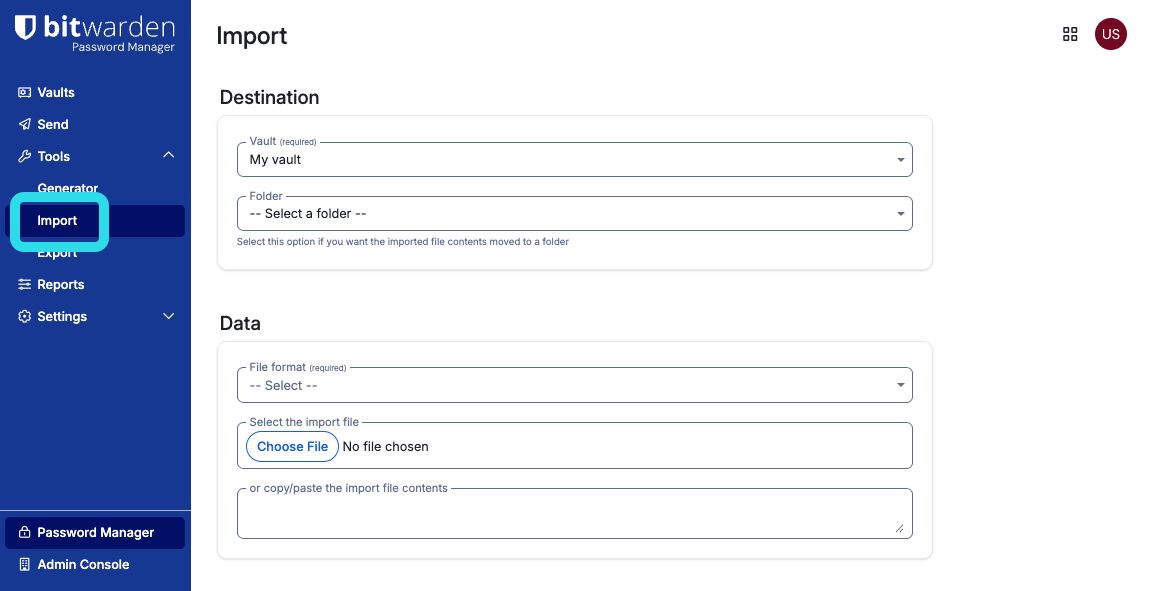
Import items From the Vault dropdown menu, select where to save the data:
To save data in your personal vault, select My vault. (Optional) Choose an existing Folder to organize the imported items.
note
If your data file contains folders from your previous password manager and you select a destination folder from the dropdown menu, the imported folders will be nested inside the folder you selected.
To save data in an organization's vault, select the organization's name. (Optional) Choose a Collection to organize the imported items and share with other members. (You can only choose a collection where you have can manage permission.)
From the File format dropdown menu, select the file format of your exported data.
To enter your data, do one of the following:
Select Choose File and pick the exported file from your computer.
Copy and paste the contents of your exported file into the text box.
warning
Importing does not check for duplicates. If you import the same file more than once or import items already in your vault, duplicate items will be created.
Select Import. If you're importing a password-protected
.jsonfile, enter the password into the Confirm vault import window that appears.After your data is imported, delete the exported data file from your computer. This will protect you in the event your computer is compromised.

If an “Import error” message appears, no data was added to your vault. Fix the import file issue and try again.